The views expressed in this blog are my own and do not represent VSO.

26 November 2011

Learning Khmer

I've been meaning to write something about the Khmer language for a while now, and I was reminded of this this morning when Tak's mum temporarily forgot that we've been speaking Khmer together for a year and decided without warning to switch to French, and I realised I was finding it much harder to understand her. This might be due to the quality of her French, which she learnt at a time when almost every French-speaker in Cambodia had been killed, but still, it felt like a milestone in my progress with Khmer. 

It's not an easy language to learn, especially as it's the first language I've studied which doesn't use the Roman script, so I'm learning entirely through speaking and listening. The good thing is that people don't expect foreigners to speak any Khmer at all. In fact I get quite annoyed about this - if I go to a cafĂ© with Tak they usually ask him what I want. But still, it means that people are very easily impressed and I get lots of nice compliments for the most basic phrases. And as the soon-to-be-realised Come Dine With Me footage will show, Ingran admitted on camera that I was better than him in our Khmer lessons back in March. 

I'm interested in languages and the logic with which they come up with their words. Some of my Khmer favourites are bear (honey tiger), giraffe (long cow), to grow up (get big and fat), jellyfish (sea cloud), and snot and ear wax (poo from the nose and ear respectively). I also like the fact that they use the same word for the inner tube of a bike and for the intestines of an animal. I've probably never eaten inner tube (though you can never be sure in Cambodia), but I'm willing to bet it doesn't taste that much worse.

About a week ago I began learning the Khmer script, because it suddenly seemed ridiculous to be illiterate at the age of 26. It looks daunting at first and I'm not sure of my teacher's pedagogical commitment (an increasingly bored Tak is teaching me), but it's very satisfying because you make progress very quickly. When I get round to learning how to type, I'll write something in Khmer.

I don't have any photos to go with any of this, so I'll just add some of the open day that was held this morning at Lauka school.  


05 November 2011

Comings and goings

Towards the end of September our ICT group said goodbye to its third volunteer. After Danny had left in March and Ingran in August, it was Dave’s turn to head back to England. We made quite an elaborate film called Come Do VSO With Dave, in which we compiled his best moments and then rated him out of ten. Most of us also managed to make it to Phnom Penh to say goodbye. And then we had a night out that was so much fun that they following day Dave decided not to leave after all. He’s just started a new VSO placement in Phnom Penh for nine months.

In Mondulkiri we have lost two volunteers though: Neil has a new placement in Phnom Penh, and Jeltje left to work in Kampong Cham. Before she left we went to the Sea Forest, and then to her house for a leaving party.


I’ve been in Mondulkiri for over a year now and haven’t written much about the Punong, the province’s largest ethnic group. While Sen Monorom town is mostly made up of Khmers, in the countryside almost everyone is Punong, and having less access to markets, education, healthcare and other services, their poverty tends to be more severe. Most are small-scale farmers and walk miles every day to sell their vegetables in Sen Monorom, carrying their produce in baskets which they wear on their back.

I’m lucky enough to have become a bit of a regular at a Punong family in Pu Trom village, as Tak and his dad have close friends there, but a bit less lucky that it’s considered very rude not to drink alcohol when visiting, so my recent progress on that front has suffered a bit of a setback. It’s always a gamble because sometimes they have the nasty 70% rice wine which is almost undrinkable, but other times they have the delicious homemade jar wine. It’s not as strong and really tasty. They don’t usually make it with clean water though, so it usually makes a reappearance of some sort the following day.

They’re very welcoming and the house always seems to have about thirty people in there. I assumed the extra people were also visiting but it turns out that it’s common for Punong men to have more than one wife, so they’re actually all members of the same family. I find it hard to imagine what that must feel like, and it also doesn’t make much economic sense as, in a country where men are the main breadwinners, that’s a lot of wives and children to support. Apparently it was also common among Khmers too until fairly recently. 

I don't have any photos but below are some of the people from Pu Trom performing traditional music at the school open day in June.


At work we’ve been helping schools to update their community maps. This involves community members and teachers drawing a map of the catchment area and filling in information such as the number of school-aged children in each house, and anything that might make it difficult for children to attend school, such as disabilities or extreme poverty. Teachers can then compare these maps with actual attendance rates and work out who is not coming to school, and can then visit these homes to find out what the problem is.


We’re also going to be doing some research on behalf of Actionaid and NEP (an umbrella group for all education NGOs in Cambodia) on children’s rights in schools. Tak and I attended a five-day workshop in Kampong Cham to train for this (although I won’t be carrying out the research myself). It was difficult as I was the only foreigner and after the first morning Tak got bored of translating. I understood most things but found it hard to contribute. It was nice to meet NGO workers from across the country though and see a group of young, educated, opinionated people who are committed to improving their country.
  

04 October 2011

Travelling in the northwest

Last week was Pchum Ben, one of the longer Cambodian public holidays and a religious festival which I still don’t really understand, except that it involves lots of parties at the pagodas. I went to the northwest with Dave and two of his colleagues, Phinet and Sharon, to visit Preah Vihear temple on the Thai border.

The four of us in Preah Vihear province
Preah Vihear is one of the most important of the Angkorian temples and probably very beautiful, although it was so foggy we couldn’t see it. Perhaps more significantly, though, it’s been the source of conflict between the Thais and Cambodians for decades because, although it was officially recognised as Cambodian by the UN in 1962, the only access was from the Thai side, leaving them effectively in control. In 1979 it was the scene of “the worst forced repatriation in UN history”, as Thailand marched thousands of Cambodian refugees fleeing from the starvation caused by the Khmer Rouge back over the border. And more recently, the ownership issue resurfaced when UNESCO awarded the site world heritage status and Cambodia built a tarmac road; this, coupled with Thai political instability and a flare-up of nationalism in both countries, led to fighting earlier this year, with several soldiers killed. There has been no fighting since February though, and the temple has been reopened to tourists.

Before we got there we had a night in Siem Reap followed by a drive up to Anlong Veng, a town close to the Thai border and the last Khmer Rouge stronghold. It was controlled by them right up until 1998 and is the resting place of many of its leaders, including Pol Pot and Ta Mok. It wasn’t an unpleasant town and people were friendly enough, but I couldn’t help wondering what kind of things they’d got up to, and what on earth they’d been thinking for so long. After lunch we visited Ta Mok’s house, a weird place because, alongside the cages where Khmer Rouge prisoners were kept, there were groups of people having picnics. Then we drove almost to the Thai border to see the cremation site of Pol Pot – he died mysteriously and was cremated the same day. It was raining and felt appropriately grim, a large mound of grey earth covered by a simple tin roof.


It was a nice drive to Sra Em, a town about 25km from the temple where we stayed the night, went to a Pchum Ben party at the pagoda, and left around 6.30 for the temple.  

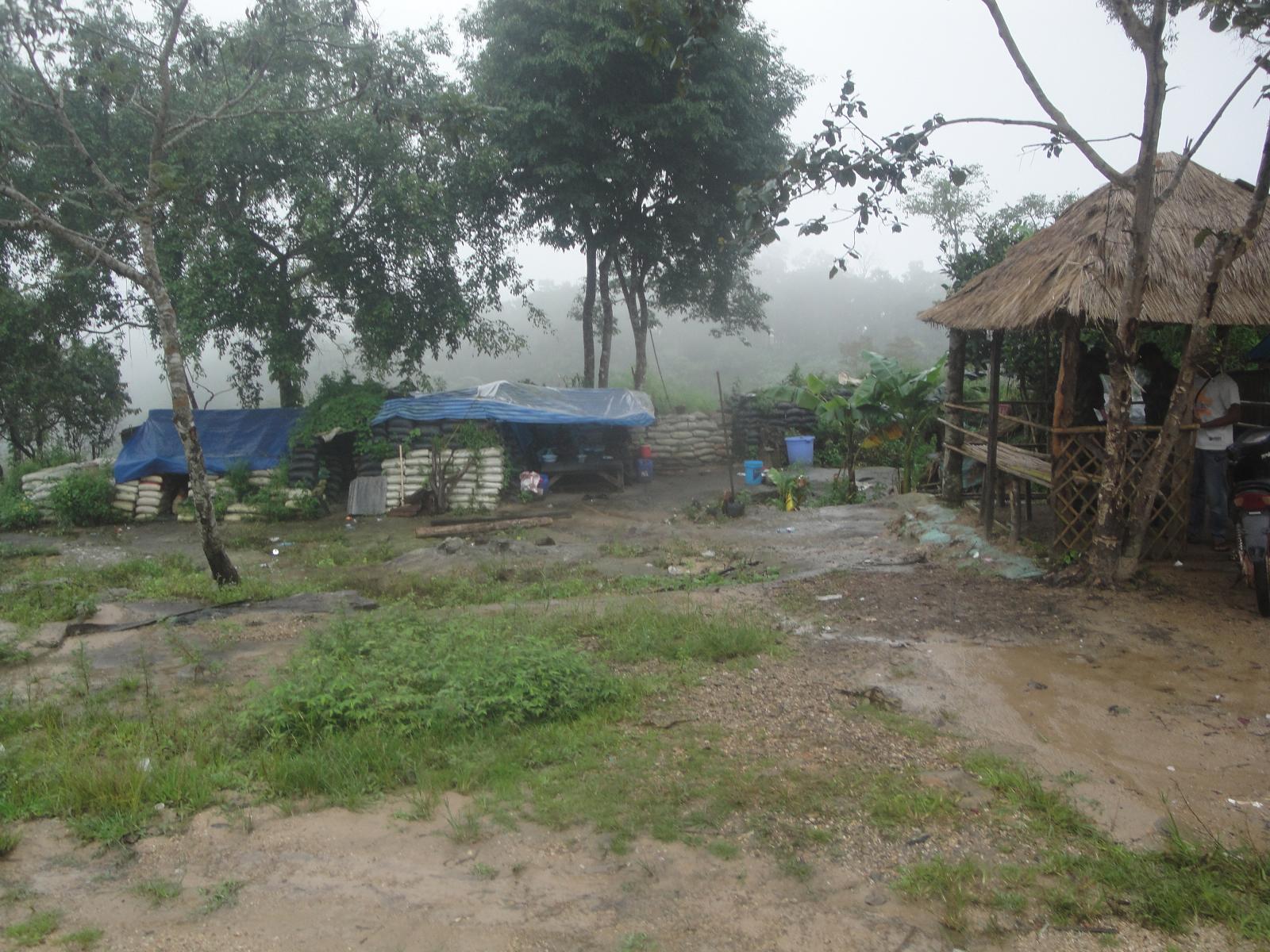
The area was heavily militarised, with lots of army buildings including one with about eight tanks, and when we reached the temple after a very steep drive, there were over a thousand soldiers stationed there. I wasn’t expecting this at all but, although the fighting is over, neither side is withdrawing its troops until the other side does. A group of soldiers offered to take us round and handed us a gun, saying we could hold it. Being a bit clumsy and wary of accidentally restarting a war, we declined. I did think though that there can’t be many national armies who, on the frontline of a warzone, would offer their guns to passing tourists. Of course, Dave and I weren’t just tourists but had military experience: at the age of 15 I did four days work experience at Altcar army training camp, and Dave once did an army fun day at school. We wondered whether to ask if they wanted us to get them some tips.


The soldiers took us round the whole site, showing us bunkers dug into the temple walls, the sandbags marking the border, the Thai military camps on the other side, and some of the damage done to the temple by Thai shooting. 

The sandbag wall is the official border

Bunkers dug into the temple walls
I’m not generally inclined to like soldiers very much, but I had lots of admiration for the ones we met. They were warm and friendly, had been there a long time without being able to see their families, and were sincere in their commitment to their country without being excessively nationalistic – they said that they no longer had a problem with Thailand since the recent change of government. And when Dave (who says he gets uncomfortable with lulls in the conversation and says wildly inappropriate things) asked if they found it difficult being so far from a karaoke bar – synonymous in Cambodia with casual prostitution – they didn’t get offended and just said that their work was more important. They didn’t even get angry when Dave when one step further and asked if they liked Thai food. 


Dave and Phinet


Three of them took us round and stayed with us the whole time, so afterwards we bought them lunch to say thank you. Dave later told me he’d come really close to asking the man serving us if they had Thai Green Curry; luckily he managed not to, and we left them on good terms. They’d been really good to us, although presumably really bored as they’d followed us around for three hours.

We drove in the rain back through Sra Em towards Tbaeng Meanchey, the capital of Preah Vihear province, which had nothing much there apart from a great bakery with the best bread I’ve had in Cambodia. We left the next morning and, after visiting a few pagodas on the way, we went back to Kampong Thom, where Dave lives. Phinet invited us for a Pchum Ben party at his cousin’s house which was fun, and the following day I left for Phnom Penh. Overall it was a great week and really fun to do some travelling again. And I’m glad that, the day after Dave’s leaving party, he decided to accept a three-month placement in Phnom Penh, so he won’t be leaving after all. 

23 September 2011

School enrolment campaigns

Apologies for not having written anything for such a long time. Things have actually been quite busy at work, even though it’s still the school holidays. As well as helping the VSO staff set up new placements in good governance and health for next year, we have had lots of workshops and, more recently, have been working on school enrolment campaigns. These take place during the last fortnight of September to sensitise parents and communities about sending their children to school. The weather this week has been terrible, though, and we haven’t always been able to attend the campaigns, but we did go to one at Pu Tang village on Tuesday. 

This was organised by the school director and they didn’t have a banner, but there was quite a good turnout from the children, who walked through the village with a loudspeaker and posters. It was nice when other children came out of their houses to join them.


The walk was about an hour and the girl in the picture above (who I think came up to my knee) managed the whole thing. I felt very sorry for her though as she probably has to do this another three or four times before she’s old enough to enrol herself.

We’ve also made a leaflet with ideas for community involvement which we are distributing to all the schools. And one day in August we had chicken, which is a very rare occasion as it’s expensive here. They’re slightly cheaper if you buy them alive, so we did, although I didn’t enjoy driving him home: he wriggled a bit and broke my eggs. I hope they weren’t related. At home I put him in the spare room, gave him a plate of uncooked rice and called him James; Tak and Eng slit his throat, plucked and gutted him. James nearly had the last laugh though as he’d left a bit of poo inside which the murderers got all over their hands. But he wasn’t laughing when he came out of Jeltje’s oven.


Anyway, I think I mentioned in my last post that my placement is being extended until March 2011. As a result I’ve decided to step back from Cambodia’s collective alcohol problem, which until now I’ve been participating in quite enthusiastically. I’d always thought it was impolite to say no, and that a year wouldn’t do much harm, but now that I’m staying longer I’m going to be more careful – especially as times are hard and we can usually only afford the lethal 70% rice wine. (Last time I think it burned through some of the lining of my stomach and gave me acid indigestion for days, so I’ve given it up completely.)

Next week it’s Pchum Ben which is a big holiday in Cambodia and most people go back to their home villages. Mine’s a bit far away (although I’ll be home from 17-30th December), so I think I’m going with Dave to Preah Vihear which is a famous temple on the Thai border. I haven’t been to the northwest year apart from a short trip to Siem Reap so that should be good.      

18 August 2011

Changes

VSO is currently finalising its new strategic plan for Cambodia and it’s likely that they will start working on good governance at national, provincial and district levels. As public services are currently being devolved to district level (at least in theory), VSO will be able to combine this with continued support for health and education: volunteers will work in small teams with some supporting public services and others supporting district councils to administer these services effectively and to improve democratic accountability. I think it will be a big challenge for VSO to work in this area as Cambodia’s culture of deference as well as widespread corruption makes democratic development very difficult, but it’s also probably the single thing needed to help move the country forward.

VSO is also planning to reduce its geographical presence to the four poorest provinces in the east, including Mondulkiri, so there will be more volunteers here over the next few years. The good news for me is that it is likely that I will be able to extend my placement for five months to continue the work on education as well as help set up the new volunteer placements, which will begin next March. As the alternative is the miserable thought of supply teaching until next September, I think I’m keen to accept.

It’s also good that Tak will keep his job and will then have new volunteers to work with in March. We might need to clarify our respective roles, though, as I definitely feel there’s been some confusion in the volunteer/volunteer assistant working relationship. In fact I think I might be the victim of some highly exploitative working practices: as well as chopping down trees to clear his land, I also seem to be expected to build his house. Last month we went to Bousra to collect wood (not from the forest, I mean; from his cousin who he’d already bought it from). I thought it was nice of him to ask me along, and was imagining a nice trip to the countryside, and maybe a break at the waterfall on the way back. For some reason it didn’t occur to me that lifting and carrying enough wood to build a family-sized house might not be that much fun. It wasn’t, especially when we arrived back in Sen Monorom and realised we had to do it all again, unloading the wood, which took hours and hours. There were 294 planks of wood altogether, and there were no Mars Bars to help us get through it.


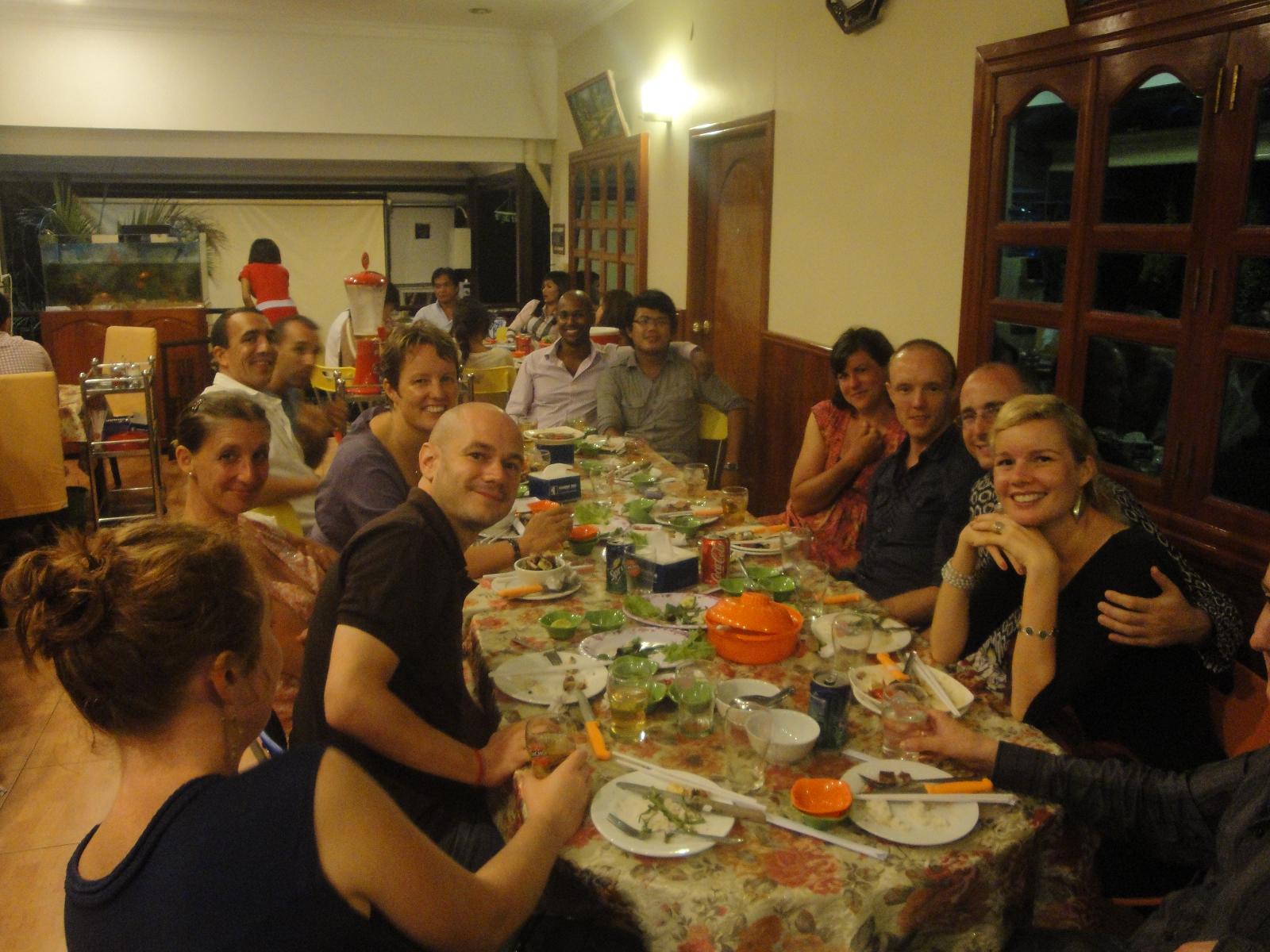
The sad news this week is that Ingran is leaving. He’s given up Cambodia for the bright lights of Watford, so it can’t be long before he’s back. But still, we’ll miss him in the meantime. Last week lots of people from our original September 2010 group came down to Phnom Penh to see him off. He's awesome and Cambodia won't be the same without him.