The views expressed in this blog are my own and do not represent VSO.

20 March 2011

February and March

It’s been a busy few weeks since my last entry. I’ve entered my 27th year, attended two funerals, had lots of VSO meetings, supported two school open days and hit a cow (on my motorbike, not with my fists). I’ve also found out that ménage à trois means more than just living together, so to clear up any confusion caused by my last blog, I’d like to clarify that, while Tak and I share almost everything, we don’t share his wife.

When we came back from Phnom Penh after the wedding, our landlady’s mother had died. She was old and had been sick for a long time, and perhaps because of this, or perhaps because of Buddhist beliefs in reincarnation, the funeral didn’t seem to be a sad affair. It took place seven days after her death and was an occasion to wish her well as she left this world, with another funeral after a hundred days to bless her new life. Everybody wore white and when we arrived we went to give our offering to one of the monks – rice, sugar, incense, candles, condensed milk and tea. These are considered the essentials for her on her journey out of this world, although after the funeral they go to the monks, who have no income and survive on donations from people. We then ate some food and left about half an hour later.

Much worse was the death of Tak’s older sister, which happened two weeks ago, as she was only 40 and died in pretty awful circumstances. This isn’t really the place to write about it.

Work has been very busy as VSO needs to finish all of its funded activities by the end of the financial year on 31st March. Tak, Jeltje and I worked together to help two schools – Pu Trom Tmei and Sreiee – organise community open days to celebrate the new libraries that they’ve recently set up. 

The new library at Sreiee
They both followed a similar format: a welcome from the school director, activities from students such as talking about their favourite books, plays and songs and reading aloud, speeches from community leaders and staff from the Provincial Office of Education, a ceremony to bless the new buildings, and a communal meal. Both communities are predominantly Punong (Mondulkiri’s largest indigenous group) and so the ceremonies were traditional Punong ceremonies, involving lots of jar wine which was delicious. 


As for the food, VSO provided a pig but community members donated everything else and organised the cooking, as we wanted the school to feel that they could organise similar events in the future without help from VSO or any other NGO. Both events were successful and well-attended, and we were pleased that staff from our office came too to show their support for the school and also to see the work that we’ve been doing. Finally, while I’m aware that almost every paragraph of my blog ends in this way, we finished by drinking a lot of jar wine. 

The following day was my birthday. Having mentioned it to Tak the day before (before the jar wine), I thought he might at least have remembered to wish me well. He didn’t, and even Jeltje only produced a cupcake instead of the birthday cake she’d promised. As the day went on I did wonder whether they were planning something, but it seemed not. I became a bit suspicious when Tak wasn’t in the office in the afternoon and Jeltje didn’t seem to know where he was (she doesn’t normally let him out without a good excuse!), but then she said something about helping his father, which was very plausible as it was the week of his sister’s funeral. Finally, at 5pm, I nearly asked Jeltje if she was going for a drink later but felt too pathetic to be fishing for an invite on my own birthday, so I went home alone. All day it had felt like a soap opera (a shit one, like Hollyoaks) and I still wasn’t sure what the ending would be.

Later, Eng said we were all eating out, and I assumed it was at Tak’s father’s to help with the funeral arrangements, and it was only when Tak came back to pick us up and, crucially, get the bottle opener (a sure sign of red wine, not Tak’s dad’s tipple of choice) that I thought they were up to something. It was a surprise party at Jeltje’s house, and it was lovely to see so many people there. I’ve never had a surprise party before and it is really nice, but organisers should be aware that it makes people feel very sorry for themselves for most of the day!

Since then a new volunteer has arrived from Belfast. He’s very nice and is living two doors away (all six of us – me, Tak, Neil, Daniel, Jeltje and To – now live within a few hundred metres of each other on the same street). We also had a visit from VSO in Phnom Penh to see how we’re doing, and that seemed to go well. It was lucky that this happened just after the open days, so the people from the POE who attended the meeting had a better idea of the work we’ve done.

I’m now in Phnom Penh about to start the second bout of language training which I’m looking forward to, although I’m annoyed that I’ve slipped down the rankings a bit as other people have improved their Khmer at a much faster rate than me. I am, however, learning the alphabet with the help of a first words book designed for Cambodian children, and I can write fork, spoon, shampoo, mother, tree, cat etc. Tak is here too although he has chicken pox (‘ot swai’ in Khmer, which sounds a lot like ‘not a mango’) and is feeling very sorry for himself. I’ve been playing chief nurse – I’m not sure why as he’s staying with his mum who is an actual nurse – but Eng is coming today so my duties are over.

Finally, my pigeon hole is overflowing with parcels which I’m going to open right now - thank you!

25 February 2011

The wedding

Reader, he married her.

 
That’s the gist of what happened last week. However, Cambodian weddings are extravagant and colourful affairs (very colourful, in fact), so for those who are interested, here’s the full account of Tak and Eng’s wedding.

To begin at the beginning, or rather, with me, about two months ago Tak announced that on the wedding day I would be the groom. I was a bit taken aback by this because I didn’t know his girlfriend very well, but it turned out he’d got mixed up and meant the best man. In Cambodia there are three best men and traditionally they should be unmarried and have both parents still alive. Many of Tak’s close friends are married already so he had a pretty empty barrel to scrape from. Still, I felt very honoured to be asked along with two of his cousins, Sinny and Lucky.

Incidentally, the Khmer word for best men is neak komdor, which sounds dangerously close to kdor, the word for penis, so I didn’t tell anybody who I was in case I accidentally told them I was Tak’s penis man. Fortunately, my bright orange and pink silk clothes were a bit of a giveaway.     

We left Phnom Penh on Sunday morning and arrived at Eng’s family’s house in rural Kampong Cham province, where the wedding would take place on the Tuesday. The family and their neighbours were busy with preparations – decorating the house, beginning the cooking, shopping, setting up the marquis and stage – and it was interesting to see everything from behind the scenes. We also had a lovely swim in the nearby Mekong. 

 
The wedding began at around 5pm on the Monday evening, with a ceremony in which four monks blessed the couple. 


Only the bride and groom were dressed up for this; the rest of us were wearing ordinary clothes, and after about half an hour of chanting it was over. Monday evening was a quiet affair as we all had to wake up early the next day, so after a few beers with Tak’s family (most of whom came on Monday as they were coming from far away), we went to bed about 9pm. 

Tak and his penis men on the night before the wedding.
Tak waltzed into the house saying he would be sleeping with Eng, and about three minutes later was frogmarched out by Eng's mother, sheepishly joining me, Lucky and Sinny outside on the veranda. Long after we went to sleep, Eng and her family were still preparing the hundreds of plates of fruit and presents which would be used for the procession the following morning.

The bride and bridesmaids (including Jeltje, who stepped in when one of Eng’s friends dropped out) were awake from about 3.30 to begin the hair, make-up and dress preparations and at 5am we were woken up too. I also had a bit of a disastrous hair styling, but it faded into insignificance when our costumes appeared. 


At around 7am we went downstairs, Tak first, then Sinny and Lucky carrying a gold umbrella each and me carrying a bouquet of flowers. When everyone started laughing I assumed it was because of the bright pink clothes, but it turned out the bouquet is supposed to be carried by the groom, as the three of them knew only too well. I wasn’t amused. Anyway, we walked about a hundred metres from the house, and all of the wedding guests who weren’t part of Eng’s family came and lined up behind us, each carrying a plate of fruit. Accompanied by music, we processed towards the house where we offered our gifts, in a ceremony that serves to underline the economic nature of traditional Cambodian weddings. (The groom pays the $3000 cost of the wedding, and although guests pay around $10 each, this money goes to the girl’s family, so they end up making a handsome profit from the sale of their daughter.)

Following this we all ate breakfast and then there were further ceremonies involving the bride and groom’s families offering each other gifts. We were also changed into orange clothes ready for the hair-cutting ceremony which took place at about 11am. 


This was downstairs and, after listening to some monks chanting again, the wedding party (the couple, best men and bridesmaids) sat on chairs in a line while two people began enacting a comic play. I found it difficult to understand and soon switched off, and so I was horrified when the microphone began working its way towards me and I was made to get up on stage with them. I had no real idea what was going on, but I think the gist of it was that the man was trying to pay me to marry the woman, and my role was to say no, which I think I managed to do. Anyway, everyone laughed a lot and I was soon allowed to sit down again. After this there were photos of family members pretending to cut the bride and groom’s hair, symbolising a shared future that begins growing from the same point.

Before lunch, we also went down towards the village to pay respects to someone’s ancestors (not sure whose). This took place just outside a school, so lots of the children came out to watch. While Tak was happily boasting about all the attention he was getting, it was pretty obvious that none of them were looking at him but were all staring at me – more than anywhere I’ve been in Cambodia so far, this is the place where people seem totally unaccustomed to seeing foreigners.

Lunchtime offered an opportunity to change clothes and go the toilet (I hadn’t been able to do that in the apsara trousers), and we had one more ceremony to attend before we could have a break – the washing of the feet ceremony. Tak put on a suit that made him look like a king, and Sinny and I stood behind him while Eng bent down and sprayed liquid soap on his feet, presumably to symbolise wifely obedience. No comment on that one.

We had an hour or so to rest (although Tak and Eng continued non-stop with various photos and ceremonies) before putting on a bright blue suit to go downstairs and greet the guests as they arrived. 


This was good fun for about an hour, then really hot and tiring for the following two hours as we could see everyone else eating and drinking. Interestingly, many of the villagers were leaving by 4 or 5pm, despite going to huge amounts of effort with their wedding costumes and hair. All in all, there were over 600 people, although not all at the same time as they came and left at different times.

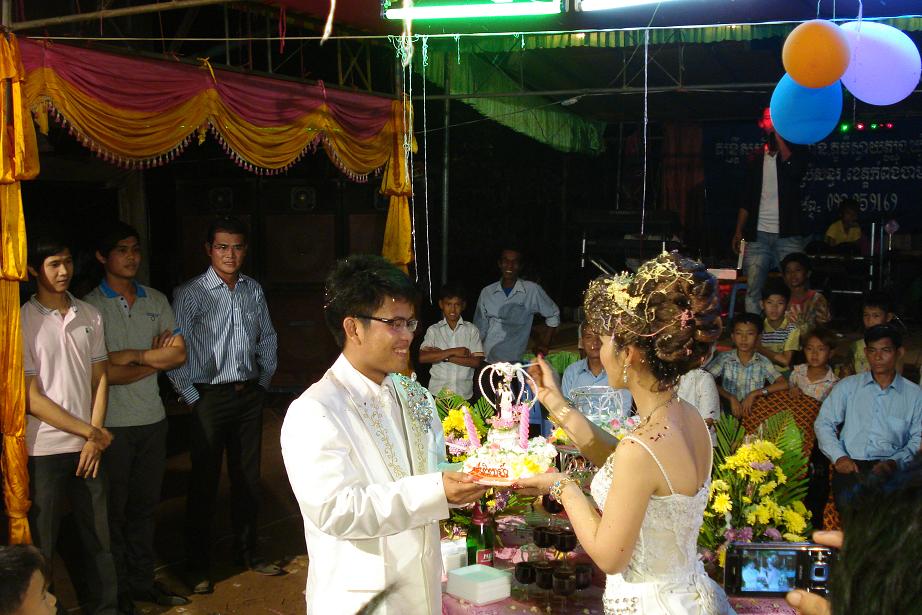
At about 6.30 we were finished and could start on the beer, which flowed very fast as lots of people wanted to drink with the foreigners. I thought the ceremonies were over but there was one more to go – a Western-influenced cutting of the cake ceremony. We wore white suits (I felt like I was in a boyband) and I took a few photos as we were waiting for it to start.


Downstairs, we walked behind the bride and groom as they were covered in confetti. Because by this stage people were a bit drunk, this ceremony was more relaxed and good fun. 

 
Less fun was the whisky which followed and which meant I got very drunk very quickly. 

 
I still managed to do some Khmer dancing which always impresses people (Cambodians don’t seem to realize that their traditional dance is the easiest in the world – you just walk around a table and move your wrists a bit). And then I did a little bit of being sick, which doesn’t impress anyone.

All in all it was a great experience to be so closely involved in and I felt very honoured that Tak had asked me. The next chapter will involve the ménage à trois that is awaiting us when we go back to Mondulkiri tomorrow as, until Tak and Eng manage to build their house, it’ll be just the three of us... 

07 February 2011

Family times

Last weekend we took Tak’s mum home to Phnom Penh, after an interesting month living all together. She is a bit like a radio with the off button broken, and at times she seems to pick up different stations at once as she drifts between Khmer and French with no warning of the signal change. Still, I have enjoyed listening and have learnt a lot – she’s like Radio 4, a shopping channel and a Cambodian National Party spokesperson all in one.

Firstly, I’ve learnt that I don’t know how to buy tomatoes, green peppers or mushrooms. Every shopping trip was followed by an examination of my purchases, with a scolding for anything that looked like it might be expensive or Vietnamese. She also taught me a lot about cabbage, which was one of her favourite subjects that she returned to at least daily. And she told me that red hair wasn’t good, but that she would forgive me because I was foreign and couldn’t help it.

Washing my clothes was a trial, as I do everything I’m not supposed to do - using the kitchen rather than the bathroom, heating up water, using too much washing powder, doing it myself when I ought to have a wife to do it for me. I think I managed to win her over on the washing up though, as she nodded approvingly at my technique. Phew.

Seriously, though, it was very nice to feel part of a Cambodian family and it felt quite authentic – Tak got infuriated and spent lots of the time avoiding her, leaving us plenty of opportunities to continue talking about cabbage. At other times they would both come home in good spirits and we would talk and have a drink which was lovely.  She is a great person and actually probably one of the most independent Cambodian women I’ve met: she is separated from her husband, drinks alcohol (most women don’t), sits with Tak’s friends when they come round (rather than retreating to the kitchen as other women do), and speaks her mind.

And in Phnom Penh, coming back from a visit to Tak’s cousin, she said she hadn’t eaten the food there because she didn’t like the thought of me not eating there too. I was very moved by this kind thought.   


Back at work, things are getting exciting. I’ve been to Phnom Penh twice recently to buy children’s books to support library projects at three primary schools. Visiting one of them today for a meeting about something else, it was great to see a group of children spending their breaktime reading. 


Once the libraries are set up, Jeltje and I are encouraging the schools to organise open days for families and community members to come to the school, discuss their children’s progress with the teachers, watch children perform something related to their learning, and cook a communal meal. If they work well, they will engage the community in their school, provide an opportunity to celebrate the children’s learning and promote the use of the library among the children as well as the community. And if they don’t work well, at least there’ll be some food.   

23 January 2011

Bousra waterfall

Mondulkiri’s biggest tourist attraction is Bousra waterfall, a massive double-drop waterfall which is so famous it’s inspired a song, although being a Cambodian song, it’s probably not very good. On Saturday I finally got round to seeing it – Jeltje’s dad is visiting at the moment, so that was a good excuse for Jeltje to talk her friend Somnang into driving us there. There were six of us altogether: Somnang, Jeltje and her dad, me, Tak and his mum.

We put ourselves in charge of catering, which was interesting. Tak’s mum and I are currently engaged in a month-long battle for rights to the kitchen (I’m trying to do my bit for the liberation of Cambodian women, but she says I don’t know how to chop tomatoes), and while Tak is normally happy to leave us to it, barbecuing meat is his forté. At 6.30 he came back from the market with a huge 1.7kg cut of beef, some carrots, cucumber and barbecue skewers, and after several hours of battle, we were on the road just after 8am.

Unlike the other waterfalls I’ve been to so far, Bousra has clearly been developed as a tourist site, with a carpark, lots of souvenir stalls and people renting out picnic mats. The foreigners among us were also asked to fork out $1 to visit the site – many of Cambodia’s tourist attractions charge foreigners but not Cambodians, which I think is quite a good policy in principle although a bit annoying for me.

Anyway, we set up camp and then went to explore the waterfall. We did things like this:


And then we did things like this:


And then we ate food like this:


And then we took photos of monks doing things like this:


It was a really good day and nice to spend time with lovely people.

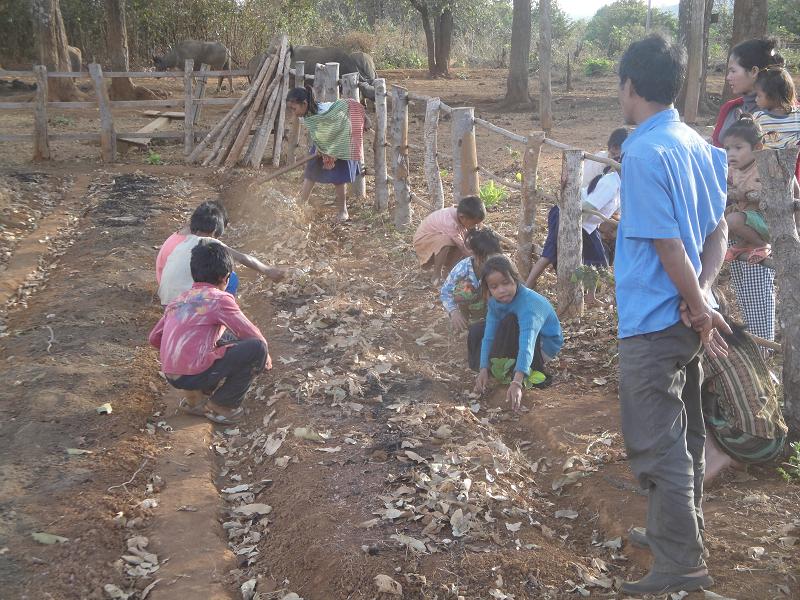
In other news, work is getting very busy as VSO want us to spend the remaining money in the budget before the financial year ends in March. We are currently organising a trip for teachers and students from three schools to visit schools in another province to get some ideas for developing their student councils. As well as that, we are hoping to support three primary schools to set up libraries, which is exciting although will involve a lot of work. One of these schools is Pu Trom Chah, which is also working on a vegetable garden. Last Thursday Tak and I went early to visit the school, and took some photos of the children and teachers working together:


And then, before we were asked to roll up our sleeves and get involved, we left. 

17 January 2011

The last few weeks

This week I have beaten Tak three times in a row at pool, crossed a river on a motorbike and rewired a plug (without any help from the internet and electrocuting myself only once). I think this is the manliest I’ve felt since my last Bruce Springsteen phase circa 2005.

Anyway, after a busy few weekends over Christmas and New Year, work has picked up again and the last week has been quite eventful. On Thursday, Jeltje, Tak and I went to Sraee again, the school in the jungle which is probably my favourite school. This time we went on our motorbikes, sharing two between three as Jeltje’s bike was broken. It was the most difficult driving I’ve done yet but I didn’t fall off and it was very satisfying to ride through a river unaided. My approach to the difficult uphill sections of the road was mostly to shut my eyes and hope for the best, and luckily it seemed to work.

At the school Jeltje did a lesson observation and then we had a short meeting with the school support committee, which is made up of about seven people – much more impressive than I’ve seen at other schools. We had brought materials to repaint the blackboards so we did that, and it was very nice to see community members, children and school staff all getting involved in some basic school improvements. It was also nice to do a bit of manual labour – I’ve always thought painting and decorating would be my kind of job, mostly because you get to listen to the radio and drink lots of tea.


Not sure what these two brought to the table while the rest of us were working hard...


The community are also starting a vegetable garden at the school which will enable them to teach children how to grow vegetables (a useful skill in this very poor village where food scarcity is a real problem), as well as producing goods which can either be used to support the neediest families, or be sold at the market in order to make money for the school to buy resources. It is equally positive that community members and the school are working together on something, as the overall purpose of my role is to help communities become more involved in school and to value education more highly. At Sraee this job is very easy as the school staff and community leaders are very enthusiastic and motivated. This is important because, for my work to be sustainable, I need to be doing as little as possible as it is the community who will be responsible for continuing the developments when VSO eventually stops working here.

After this positive visit, I went to my first Cambodian wedding on Friday. I didn’t know the bride or groom, and barely knew the bride’s father who was the one who invited us (he works at our office). In Cambodia guests don’t bring presents but pay about $10 as they leave, meaning families tend to make their money back on weddings, so inviting strangers isn’t that unusual. It also makes the families look good to have big lavish weddings and apparently it also looks good to have a few foreigners there.

Anyway, we sat down at a table and, when it had filled up, we were served some tasty food. Each table had a bottle of brandy as well as lots of beer, and a drunk man quite high up in our office came over, said hello, was very friendly in a drunken way, and stole our brandy. Sadly he’s a deputy director, so we couldn’t take it back. Still, we had lots of beer (which I prefer anyway) and then went round saying hello to other people we knew and were inevitably hauled up for some Khmer dancing. It was lots of fun and a good practice run for Tak’s wedding which will be at some point over the next few months.


On Saturday I was invited to go for a barbecue at a waterfall called Kball Preah, about an hour away by motorbike. It was a beautiful place and, when we arrived, there were a group of kids swimming and playing in the water, all of whom I knew from helping with their English class at the secondary school. Being Cambodian children, they are all very friendly, although strangely they left soon after we arrived, and it wasn’t until about an hour later that I realised they should have been in school as Saturday is a school day. Still, at least they’re doing something exciting when they skive rather than hanging around bus stops and going to McDonalds.

Today we’ve been planning our work over the next few months, as VSO’s financial year ends in March and they are keen to spend any remaining money, so we need to organise projects quite quickly. And this afternoon someone at the hospital phoned to ask if I could give blood. I was very glad too, although I regretted having my bicycle rather than motorbike, as I didn’t fancy cycling up the steep hills after giving blood.

I hadn’t been to the hospital before and it was an interesting experience. I am always reluctant to criticise hospital staff because I think it’s a tough job in any country, and I must say I was very impressed with their professionalism and the work I saw given the scarcity of equipment. Before they took my blood my landlady, who is a nurse at the hospital, took me to see the patient who needed it. I had misunderstood and thought she was going to show me round the hospital, and seeing the sick woman wasn’t a pleasant experience. She had been heavily pregnant and had begun haemorrhaging, but as she lived in Koh Nek, a remote district far from Sen Monorom, she had arrived at the hospital too late. When I saw her, the baby was dead inside her and she was bleeding severely. She looked very young and I thought she was a child at first; she was shivering in pain under a blanket, with tissues on her bed soaking up some stray blood which had escaped from her evidently inadequate bandaging. The staff took blood from someone else too and I think they are planning to operate tomorrow.

Sen Monorom is a beautiful and quite wealthy town, a place where some of Phnom Penh’s rich have their holiday homes, and especially in the first few months of living here, with exciting new experiences every week, it can be easy not to see the real poverty that exists in Mondulkiri. It is, statistically, one of the poorest provinces in one of Asia’s poorest countries. It is a province where the nearest hospital can be six hours away, or unreachable in the rainy season; where the nearest decent hospital is in Phnom Penh; where the poor can’t afford to go to hospital anyway; where children don’t go to school because their families can’t feed them if they don’t help with the farm; where many who do go to school sit and do nothing because they don’t have enough money to buy pencils or schoolbooks; where communities see their land taken away from them because they do not have the level of education to fight against illegal land grabbing by large companies; where corruption is so rife that those unable to pay are always disadvantaged.

I have had a great time here so far and although I don’t think there’s anything wrong with that, it’s useful sometimes to remember that that’s not what we’re here for.